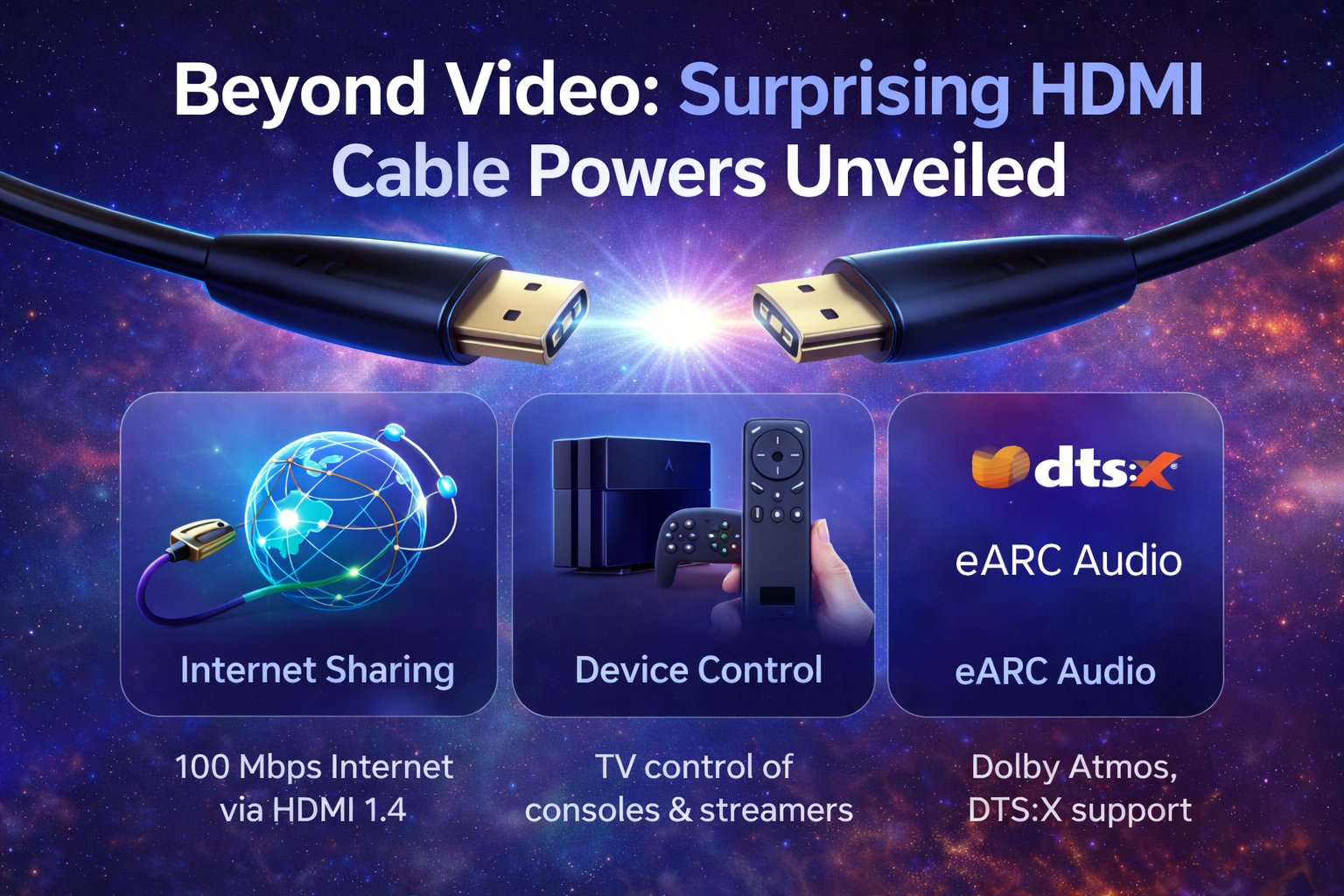
It’s More Than Just Video and Audio
For most people, an HDMI cable is simple: plug it in, and it transfers high-quality video and audio from one device to another. Whether you’re connecting a gaming console to a TV or a laptop to a monitor, HDMI is considered just a display cable.
But here’s the truth:
HDMI technology is far more powerful than most users realize.
Beyond video and sound transmission, HDMI supports internet sharing, device-to-device control, and advanced lossless audio formats like Dolby Atmos — all through a single cable.
Let’s explore the hidden capabilities of HDMI and understand what it can really do.
1️⃣ HDMI Can Transmit Internet (HDMI Ethernet Channel – HEC)
Back in the HDMI 1.4 specification, a feature called HDMI Ethernet Channel (HEC) was introduced. This allowed compatible devices to share an internet connection through the HDMI cable itself.
What Was the Purpose?
The idea was simple:
If your Smart TV is connected to the internet via Ethernet, and you connect another compatible device using HDMI 1.4 with Ethernet support, the internet connection could be shared through the HDMI cable.
This eliminated the need for a second Ethernet cable.
Speed Capability
- Up to 100 Mbps
- Bi-directional data communication
- Reduced cable clutter
How It Worked
Imagine this setup:
- Your Smart TV is connected to your router.
- You plug a compatible Blu-ray player or gaming console into the TV using an HDMI cable with Ethernet support.
- The connected device can access the internet through the TV’s connection.
Simple, efficient, and clean.
Why It’s Rare Today
Although HDMI Ethernet Channel sounded revolutionary, it didn’t become widely adopted. Why?
- Wi-Fi became faster and more reliable.
- Most devices added built-in Ethernet ports.
- Router placement became more centralized.
- Wireless standards improved dramatically.
As a result, modern HDMI 2.0 and 2.1 cables rarely emphasize Ethernet support anymore.
Still, it’s one of the most overlooked features in HDMI history.
2️⃣ HDMI-CEC: One Remote to Control Them All
Another powerful HDMI feature is Consumer Electronics Control (CEC).
HDMI-CEC allows devices connected via HDMI to send control commands to each other.
That means one device can control another without infrared signals.
How It Works
When HDMI-CEC is enabled:
- Your streaming device can turn your TV on or off.
- Your gaming console can automatically switch your TV input.
- Your soundbar can adjust volume using your TV remote.
All through the HDMI cable.
Real-World Example
If you use an Amazon Fire TV Stick, you may notice:
- The remote doesn’t rely on infrared.
- Yet it can power your TV on or off.
Here’s what happens:
- The Fire TV remote connects to the Fire Stick via Bluetooth.
- The Fire Stick sends power commands to the TV using HDMI-CEC.
- The TV responds through the HDMI connection.
No IR signal required.
Gaming consoles like PlayStation 5 and Xbox Series X also use HDMI-CEC to automatically turn on your TV when the console boots up.
Different Brand Names for CEC
Manufacturers often rename HDMI-CEC:
- Samsung – Anynet+
- Sony – Bravia Sync
- LG – Simplink
- Panasonic – Viera Link
Despite different names, they all use the same HDMI-CEC standard.
Benefits of HDMI-CEC
✔ Fewer remotes
✔ Automatic input switching
✔ Seamless device power control
✔ Simplified home theater setup
It’s one of the most convenient features in modern entertainment systems.
3️⃣ HDMI eARC: Advanced Audio Return Channel
One of the most important modern HDMI features is eARC (Enhanced Audio Return Channel).
To understand eARC, we must first understand ARC.
What Is ARC?
ARC (Audio Return Channel) allows a TV to send audio back to a soundbar or AV receiver using the same HDMI cable that receives video.
Before ARC, users needed a separate optical audio cable.
ARC simplified this.
What Makes eARC Better?
eARC, introduced with HDMI 2.1, significantly upgrades audio capability.
It supports:
- Dolby Atmos
- DTS:X
- Uncompressed 5.1 and 7.1 surround sound
- High-bitrate audio formats
- Lossless audio transmission
This means you can connect:
TV → Soundbar → Gaming Console
And still receive full-quality surround sound without extra cables.
Why eARC Matters
If you’re watching:
- Netflix with Dolby Atmos
- Blu-ray movies
- 4K HDR content
- Gaming with immersive audio
eARC ensures you hear the audio exactly as intended.
Without eARC, audio may be compressed or downgraded.
With eARC:
✔ One HDMI cable handles everything
✔ No optical cable needed
✔ Cinema-quality sound
✔ Clean and simple setup
It’s essential for serious home theater users.
4️⃣ What HDMI Really Focuses on Today
Modern HDMI standards — especially HDMI 2.0 and HDMI 2.1 — prioritize performance improvements in video and gaming.
Higher Resolutions
- 4K at 60Hz (HDMI 2.0)
- 4K at 120Hz (HDMI 2.1)
- 8K support
- Dynamic HDR
Gaming Enhancements
- Variable Refresh Rate (VRR)
- Auto Low Latency Mode (ALLM)
- Quick Frame Transport (QFT)
- Reduced input lag
These features are crucial for:
- PlayStation 5
- Xbox Series X
- High-end gaming PCs
HDR Improvements
Modern HDMI supports:
- HDR10
- Dolby Vision
- Dynamic HDR formats
This enhances brightness, contrast, and color depth.
HDMI Versions Quick Breakdown
| HDMI Version | Major Features |
|---|---|
| HDMI 1.4 | 4K (30Hz), HDMI Ethernet Channel |
| HDMI 2.0 | 4K (60Hz), Better color depth |
| HDMI 2.1 | 4K (120Hz), 8K, eARC, VRR |
Each new version improves bandwidth and capability.
Does Cable Quality Matter?
Yes — but not in the way most people think.
For standard 1080p or 4K 60Hz, most certified HDMI cables work fine.
For:
- 4K 120Hz gaming
- 8K content
- eARC lossless audio
You need a certified Ultra High-Speed HDMI cable.
Cheap, uncertified cables may cause:
- Signal dropouts
- Flickering screens
- Audio sync issues
Always check for official HDMI certification when buying premium cables.
Common Myths About HDMI
Myth 1: All HDMI Cables Are the Same
Not true. Cable categories matter for bandwidth and features.
Myth 2: Gold-Plated Connectors Improve Quality
Gold plating prevents corrosion — it does not improve video quality.
Myth 3: Expensive HDMI Cables Give Better Picture
If two cables meet the required specification, the picture quality will be identical.
HDMI is digital — it either works properly or it doesn’t.
Final Thoughts
HDMI is far more than just a “video cable.”
It can:
✔ Share internet (HDMI 1.4 – up to 100 Mbps)
✔ Control devices via HDMI-CEC
✔ Deliver Dolby Atmos and DTS:X through eARC
✔ Reduce cable clutter
✔ Power advanced gaming and HDR experiences

Leave a Reply