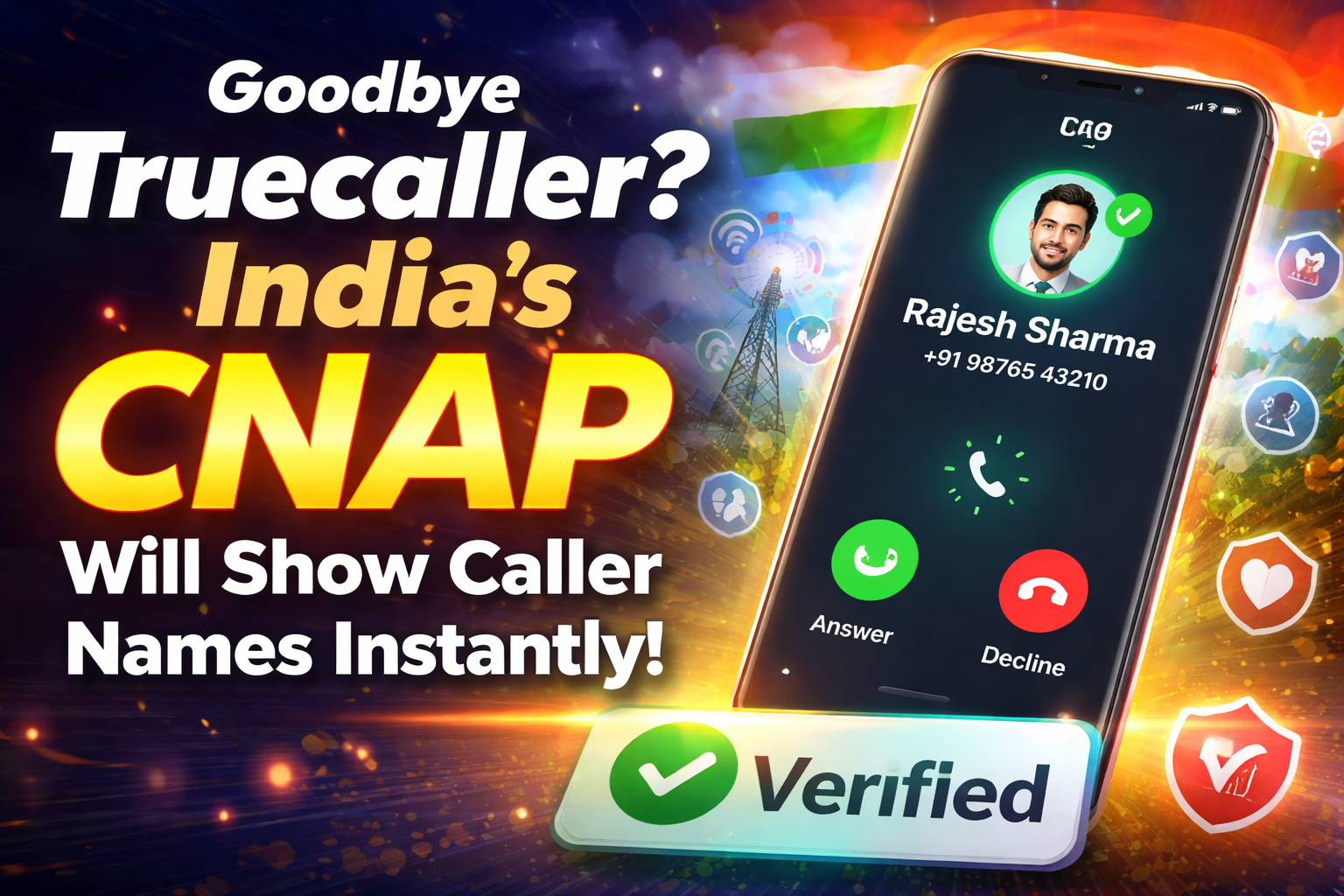
🇮🇳 India to Roll Out CNAP: A Major Upgrade to Caller Identification
India is preparing for one of the biggest telecom upgrades in recent years — a change that could redefine how we identify incoming calls.
For years, millions of Indians have depended on third-party caller ID apps to detect spam, identify unknown numbers, and avoid fraud calls. But that may soon change.
A new system called CNAP (Calling Name Presentation) is expected to display verified caller names directly on your phone screen — automatically, without needing any app.
If fully implemented nationwide, CNAP could significantly reduce reliance on third-party caller ID platforms and make telecom networks themselves responsible for identity transparency.
Let’s break down what this means, how it works, and why it matters.
📡 What Is CNAP?
CNAP stands for Calling Name Presentation.
It is a network-level caller identification system that displays the verified name of the caller as soon as your phone rings.
Unlike app-based solutions, CNAP:
- Does not require installation of any app
- Does not depend on internet connectivity
- Works directly through telecom operators
- Displays name based on official SIM KYC records
That last point is crucial.
Instead of relying on user-submitted or crowdsourced information, CNAP uses the telecom operator’s verified customer database.
This means the displayed name should match the official identity used during SIM registration.
In theory, this makes it more authentic and harder to manipulate.
🔍 CNAP vs Truecaller: What’s the Real Difference?
Let’s compare the traditional app-based model with the new telecom-based approach.
| Feature | Truecaller | CNAP |
|---|---|---|
| Data Source | Crowdsourced database | Official telecom KYC records |
| Internet Required | Yes | No |
| App Installation | Mandatory | Not required |
| Name Accuracy | May vary | Based on verified SIM identity |
| Level of Integration | App-based overlay | Network-level |
App-based caller ID systems work by building large databases from user contributions and reported contacts.
This can sometimes lead to:
- Incorrect names
- Outdated information
- Spam tagging errors
- Privacy concerns
CNAP aims to eliminate these inconsistencies by shifting identification responsibility to telecom networks.
Instead of guessing who is calling, the network itself presents the registered name.
That’s a major structural change.
🛡️ A Big Win Against Spam & Fraud Calls
India receives millions of spam and scam calls daily.
These include:
- Loan scams
- KYC update fraud
- Fake customer care calls
- Investment schemes
- Impersonation attempts
Because many scam calls come from unknown numbers, people often hesitate to answer legitimate calls as well.
With CNAP enabled:
✔ Caller’s verified name appears instantly
✔ Easier identification of unknown callers
✔ More informed decision before answering
✔ Reduced anonymity for fraudsters
If scammers know their registered SIM name will be shown clearly, it may discourage misuse.
This could significantly strengthen India’s fight against telecom fraud.
However, it’s important to note:
CNAP identifies the SIM holder — not necessarily the person physically making the call.
Still, it raises the transparency barrier.
🔐 Privacy Control: The CLIR Option
One major concern people have is privacy.
If names are shown by default, what about those who want anonymity?
That’s where CLIR (Calling Line Identification Restriction) comes in.
Users who prefer privacy can activate CLIR to:
- Hide their name
- Hide their number
- Restrict identification display
This ensures that CNAP does not eliminate personal choice.
The system may be enabled by default, but users retain control over visibility.
Balancing transparency and privacy will be critical for public acceptance.
📅 Rollout Timeline in India
The proposal for CNAP implementation has been recommended by:
Telecom Regulatory Authority of India (TRAI)
Telecom operators across India are expected to comply with the framework.
If implemented as planned:
- Nationwide rollout could begin progressively
- Full availability is expected by March 2026
- It will work across major telecom networks
India’s telecom ecosystem includes major players like:
- Reliance Jio
- Bharti Airtel
- Vodafone Idea
Once implemented, CNAP will function at the operator level, not device level.
That means:
- Works on basic phones
- Works on smartphones
- No dependency on Android or iOS apps
This universal compatibility is a game changer.
📱 What This Means for Smartphone Users
For smartphone users, CNAP could:
- Reduce dependency on third-party apps
- Improve battery efficiency (no background caller ID apps running)
- Enhance privacy (less data shared with external platforms)
- Provide consistent identification across devices
It also reduces the need to grant:
- Contact access
- Call log permissions
- Background data permissions
Your telecom network handles identity display instead of an external app.
That shifts control back to regulated telecom infrastructure.
🌍 Global Context: Is India Ahead?
Some countries already use network-level caller name systems, especially in enterprise telephony environments.
However, implementing it at national scale for consumer telecom users is complex.
India’s massive subscriber base makes this rollout ambitious.
If successful, India could set a global benchmark for telecom-level identity transparency.
Given the scale of digital fraud in emerging markets, CNAP may become a model for other nations.
⚠️ Challenges & Limitations
While promising, CNAP is not flawless.
Potential concerns include:
- SIM cards registered under generic or outdated names
- Corporate SIMs with company names only
- Family-shared numbers
- Delays in KYC updates
Accuracy depends entirely on clean telecom databases.
If KYC records are outdated, displayed names may not always reflect reality.
Another challenge:
Fraudsters using stolen identities may still bypass identification.
CNAP improves visibility — but it’s not a complete anti-scam solution.
📊 The Bigger Telecom Shift
CNAP signals a broader shift in India’s telecom landscape:
From reactive spam detection
To proactive identity verification
Instead of relying on community reporting after spam occurs, CNAP identifies the caller before the call is answered.
This transition marks a structural change in how telecom security works.
It strengthens:
- Consumer awareness
- Accountability
- Transparency
And it reduces the power of anonymous calling.
💬 Will This Kill Truecaller?
Not necessarily — but it will reduce its dominance.
Apps like Truecaller may still offer:
- Spam reporting communities
- Business verification services
- Call recording features
- Advanced filtering
However, their core function — identifying unknown callers — may become less essential once CNAP is fully operational.
The telecom network itself becomes the identifier.
That’s a significant shift in power dynamics.
🔮 The Future of Phone Calls in India
Imagine this scenario:
Your phone rings.
Before you answer, you see:
“Rahul Sharma – Verified SIM Holder”
You instantly know whether to pick up.
No app.
No internet dependency.
No guessing.
That’s the promise CNAP aims to deliver.
If executed properly, this could mark the beginning of a new era in caller identification.
✅ Final Thoughts
India’s telecom ecosystem is evolving rapidly.
With CNAP:
✔ Verified caller names displayed instantly
✔ Reduced dependence on third-party apps
✔ Stronger defense against fraud
✔ Built-in privacy control via CLIR
✔ Network-level transparency
This is more than a feature update.
It’s a telecom infrastructure upgrade.
Whether it completely replaces caller ID apps or simply reshapes them, one thing is clear:
The way India receives phone calls is about to change.
And CNAP may be leading that transformation. 🚀

Leave a Reply