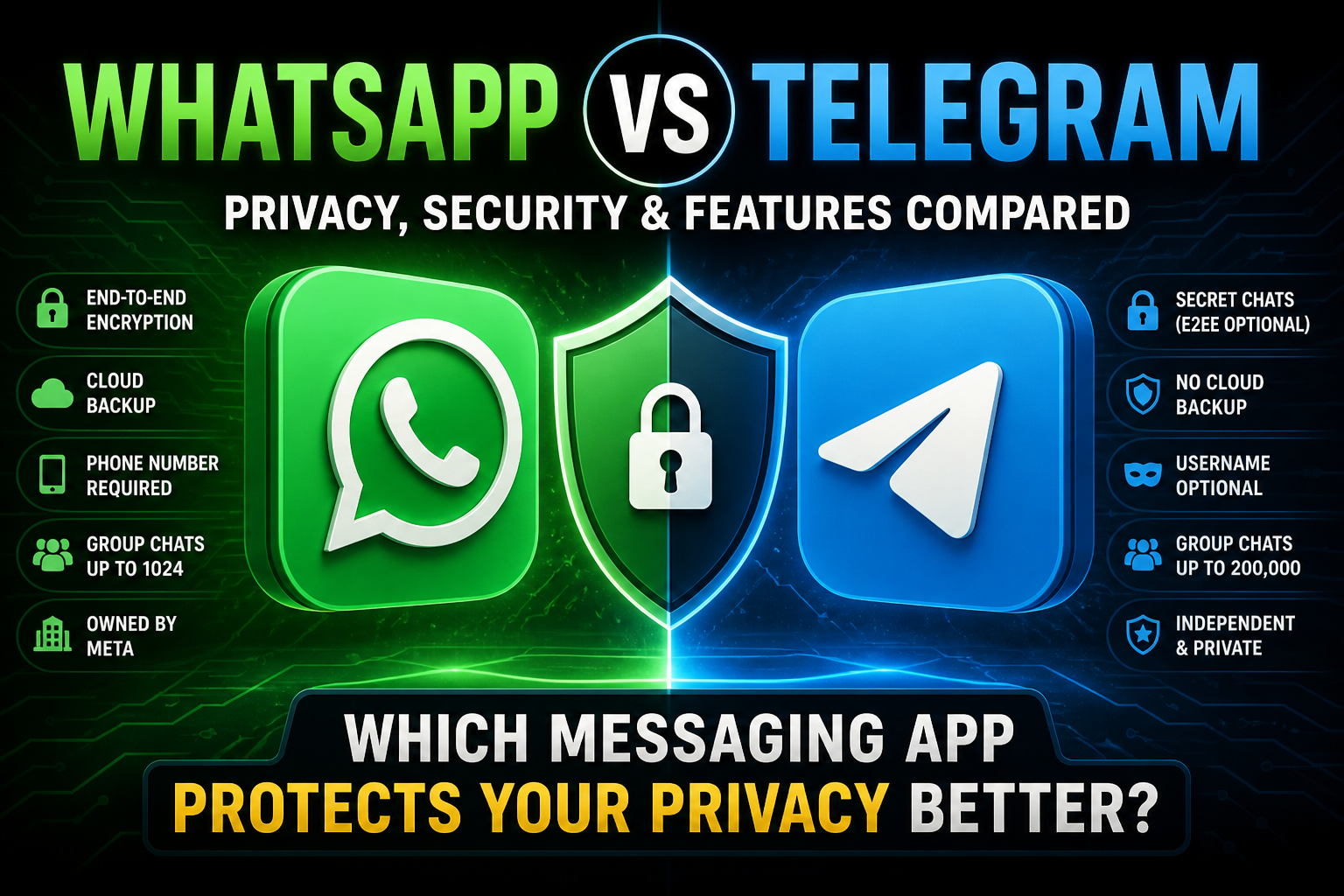
🔐 Privacy War 2026: WhatsApp vs Telegram – Who Really Owns Your Messages?
There’s a quiet assumption most people carry in their pocket every day: my chats are private.
Not “mostly private.” Not “private if I configure settings correctly.” Just… private.
But the moment you compare WhatsApp and Telegram, that assumption starts to crack.
Because this isn’t just a comparison of two apps. It’s a clash of two philosophies—one built on default protection, the other on user-controlled freedom. And somewhere between those two ideas is the uncomfortable truth about who really owns your messages.
📱 The Comfort of Encryption (and Why It’s Not Enough)
If you’ve ever seen the phrase “end-to-end encryption,” you’ve probably felt a small sense of relief. It sounds technical, powerful, almost bulletproof.
And to be fair, it is powerful.
On WhatsApp, every message you send is encrypted by default. That means:
- No one—not even the company—can read your chats
- Messages are scrambled between your phone and the recipient’s device
But here’s the part that rarely gets explained clearly:
👉 Encryption protects content, not context.
Imagine sending a letter in a locked box. Nobody can read what’s inside—but they can still see:
- Who you sent it to
- How often you send letters
- What time you send them
That “outside data” is called metadata, and it’s incredibly revealing.
So while WhatsApp protects what you say, it still observes the pattern of your life. And patterns, over time, can say more than words.
🟢 WhatsApp: Safety on Autopilot
A major benefit of WhatsApp is its user-friendliness. There’s nothing you have to fiddle with, activate some hidden feature, or understand a single line of technical gibberish.
You install the app, write a message—and voila!—you are automatically secure.
This is no minor benefit, but actually a big one.
And here’s why:
Most users do not
Check their app settings
Activate additional security features
Even know about such settings and features
Wholesomely taking care of these concerns, WhatsApp takes care of everything on your behalf.
But there is a catch here.
Owned by Meta, WhatsApp is a product embedded within an ecosystem whose success hinges upon insights generated from its usage.
While all messages are encrypted, WhatsApp is aware of your:
Social network
Usage patterns
Engagement levels
👉 So, imagine yourself having conversations in a sound-proofed room… where there are cameras everywhere around.
🔵 Telegram: Freedom That Requires Responsibility
Telegram feels different the moment you use it.
It is quicker, more flexible, and more open than before. Log in to any device instantly. Synchronize chats across platforms as if by magic.
But there is a base for that magic, and the base is cloud-based storage.
By default:
messages are stored in Telegram’s cloud-based servers
conversations are not end-to-end encrypted
This comes as a shock to most users.
Since Telegram has got an impressive security feature—end-to-end encryption. But this encryption works in Secret Chats, exclusively.
The twist is:
Secret Chats require manual activation
they work in one device
they do not synchronize across your account
Most people, however, don’t use them.
👉 In a way, while Telegram provides you the tools to ensure privacy, it leaves the decision upon yourself.
It trusts you with its features.
⚖️ The Hidden Trade-Off Most Reviews Ignore
Most comparisons end with feature lists:
“This app has encryption”
“That app has cloud syncing”
The actual difference lies not in the technology but in the behavioral psychology.
Here’s a simpler way to put it:
“WhatsApp keeps your messages secure without asking you to think about it”
“Telegram lets you do whatever you want—provided that you know how to think about it”
And here comes the harsh reality:
👉 Most people don’t think about it.
What this means for WhatsApp vs Telegram:
“WhatsApp makes you secure without any effort”
“Telegram leaves you vulnerable by default”
🧠 The Psychology of “Feeling Safe”
This is where things get interesting—and rarely discussed.
Apps aren’t selected for their architecture. Apps are selected for their security.
WhatsApp feels secure because it promises encryption.
Telegram seems futuristic by providing options.
But perceptions can be deceiving.
Consider this:
The WhatsApp user may give away too much information due to encryption.
The Telegram user may overlook Secret Chats due to trust in the system.
👉 In both instances, the flaw isn’t with the application itself but with the perception.
Privacy is compromised not by hackers.
Privacy is compromised by illusion.
🔍 So Who Actually Owns Your Messages?
Let’s strip away marketing and answer this honestly.
On WhatsApp:
- You own your message content
- The platform understands your communication patterns
On Telegram:
- You control your privacy settings
- The platform stores your data unless you opt out
Neither system is “bad.” They’re just built differently.
But ownership isn’t just about data—it’s about control vs awareness.
👉 If you don’t understand how your app works, you don’t fully own your privacy.
🔐 Security vs Convenience: The Silent Battle
Here’s something most users never consciously realize:
Everything that you like will have to sacrifice some privacy.
Multi-device synchronization -> need for cloud storage
Easy accessibility -> need for server-side information
Automatic recommendations -> need for behavior monitoring
Telegram is more about flexibility
WhatsApp is more about security
And neither can provide both at once.
👉 Privacy comes at a price.
But the important thing here is what price are you paying for privacy without even realizing it?
⚠️ The “Real World” Factor
In theory, encryption and settings matter.
But in real life?
Most privacy risks don’t come from apps being hacked. They come from:
- Screenshots being shared
- Devices being unlocked
- Backups being stored insecurely
- Messages being forwarded
That means even the most secure app can’t protect you from human behavior.
👉 Technology can lock the door.
But it can’t stop you from leaving it open.
🏆 Final Verdict: Which One Should You Trust?
If you want a simple answer, here it is:
- Choose WhatsApp if you want automatic protection with minimal effort
- Choose Telegram if you want control, flexibility, and advanced features
But if you want the honest answer:
👉 Neither app is “the most secure” on its own.
The most secure setup is:
- Understanding how your app works
- Using its features correctly
- Being aware of your own habits

Leave a Reply