For years now, Android updates have been predictable.
A few changes in design.
A couple of new widgets.
Performance tweaks here and there.
AI features that seemed amazing in presentations but made little difference in terms of actual use.
But this time things seem to be changing.
Instead of making Android appear smarter, Google seems to be rethinking its whole approach to smartphones. And let me tell you, this might just be the most fundamental philosophical change that Android will undergo since the very emergence of the smartphone era.
Because what we have right now is not yet another Android update.
This is the start of Android transforming into a fully-fledged AI-intention-based platform.
And that makes all the difference.
The Biggest Difference Between Android and Apple Right Now
One of the clearest reasons people are suddenly paying serious attention to Android again is because Google and Apple are approaching AI in completely different ways.
At the moment, Apple Intelligence seems more like an assistive layer.
It allows for notifications’ summaries.
Creation of images.
Organization of information.
Effective? Certainly.
However, Google’s plans for Android appear much more ambitious.
Whereas in the former case, an AI assistant is created to receive commands, in the latter one, an AI system seems to be created to understand intentions and perform actions on its own.
The difference is huge.
Android gradually becomes a platform where AI is not only incorporated into applications but also operates over them.
And when this happens, everything changes.
Gemini Is Turning Android Into an Action-Based System
The biggest evidence of this shift is Gemini.
What Gemini is beginning to do goes far beyond anything previously achieved by conventional voice assistants.
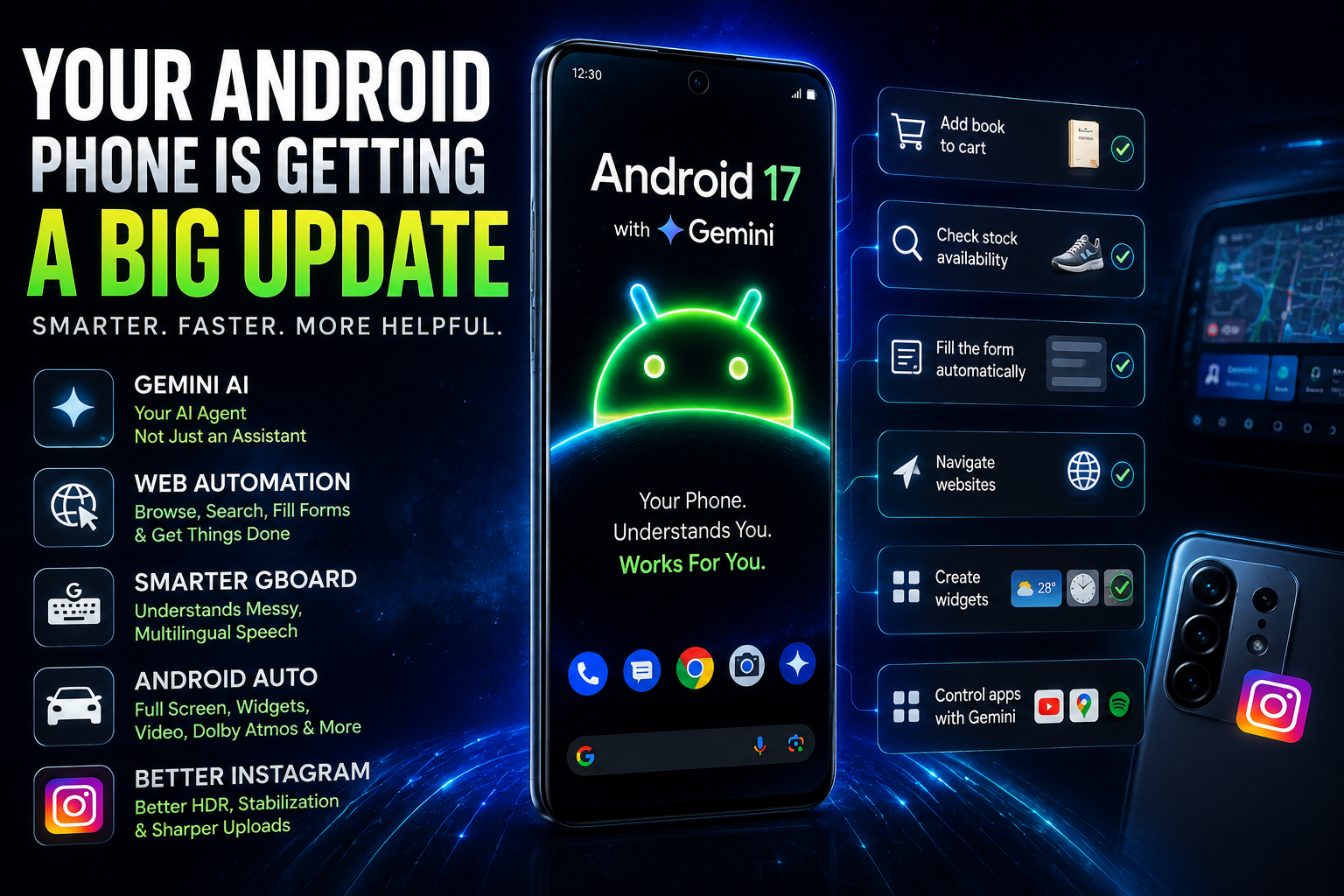
It’s an artificial intelligence that can:
Surf websites
Automatically fill out forms
Check product availability
Add products to cart
Interpret spoken commands
Handle repetitive tasks
Work on multiple apps and Chrome at the same time
Create widgets dynamically
Communicate with you as though it were a digital personal assistant
These are some capabilities that people used to dream of from voice assistants nearly a decade ago.
Back then, they could answer questions related to the weather or set alarms, yet they struggled to handle more complicated workflows. They didn’t understand context and couldn’t navigate the natural messiness of human communication.
Now Google is clearly determined to fix this issue.
If they succeed, it might be the first time that Android becomes a platform where the concept of apps is entirely abandoned.
No need to open applications and click around. You tell Android what you want, and it executes the whole process for you.
The India-Focused AI Advantage Nobody Is Talking About
One of the most underrated improvements coming to Android is the new multilingual language understanding inside Gboard and Gemini.
This is particularly true for countries like India.
Humans do not speak in perfect sentences all the time.
The common aspects of human speech include:
- Combining English with Tamil, Hindi, and Malayalam
- Resuming sentences halfway
- Altering tone during conversations
- Using filler words such as “uh…” and “wait no…”
- Switching from one language to another
Voice typing technology fails to deal with this type of conversation since it relies heavily on word recognition rather than intent understanding.
Google’s Gemini-based language systems seem to be built to handle chaotic human speech.
This is a major usability leap forward.
If Android learns how humans really speak, especially those using multiple languages, it immediately becomes more useful than previous generations of artificial intelligence.
This could end up being one of Google’s best bets in developing nations.
Android Auto Is Finally Becoming Modern
Another surprisingly important area receiving major upgrades is Android Auto.
And really, this was long overdue.
Modern vehicles come with massive screens, yet most infotainment systems continue to use small UI panels and old-fashioned designs.
It seems like Google is finally solving this problem in the right way.
According to rumors, the upcoming Android Auto update will bring:
- Full-screen support Widgets
- More optimized display for large screens
- Dolby Atmos improvements
- Video playback when stationary
- Multitasking layout improvements
While these improvements might sound simple at first glance, they can make a huge difference in practical use cases.
As more and more modern cars become digital environments rather than just modes of transportation, having Android Auto become an advanced OS layer is logical.
And Google definitely understands that trend.
The Instagram Camera Problem Might Finally Be Fixed
One of Android’s biggest long-term weaknesses has never actually been hardware.
It’s been app optimization.
There are many flagship Android phones with amazing cameras that in some instances actually beat the iPhone in straight-up photo performance.
However, social media apps have traditionally done a poor job of processing Android uploads.
This leads to:
Poor HDR performance
Poor sharpness
Less stabilization
Over-compression
Poor performance in night mode uploads
In contrast, iPhones generally offer a cleaner and more stable upload process when using Instagram or Snapchat.
This was one of the key strengths that Apple had in its ecosystem.
However, Google and Meta appear to be fixing that problem for Android users.
If successful, this would give Android creators:
- Better HDR support
- Better stabilization
- Sharper images
- Improved performance in low light
- Consistent social media uploads
If this comes true, Apple’s ecosystem strength is severely diminished.
But There Are Still Some Real Concerns
Despite all the excitement, Android’s AI future still comes with important realities.
First, many Gemini-powered features will likely remain exclusive to premium devices initially.
This implies that:
Google Pixel smartphones
Flagship Samsung smartphones
Top-of-the-line Snapdragon chipsets
Less expensive devices may only get reduced or delayed implementations.
The second point is that stage demos always look better than real-life implementations.
Automated AI systems that operate within apps need to be optimized. They can still run slowly and inconsistently in some cases.
Then there’s also the problem of cloud dependence.
The more advanced the AI functions on your smartphone, the more cloud-dependence it requires, raising questions around:
- Privacy
- Data harvesting
- Network latency
- Dependability
- Long-term infrastructure costs
Power consumption and memory usage could also become serious issues when running AI algorithms on Android devices.
Thus, even though it sounds like an exciting idea, how well this works in practice will determine its success.
The Biggest Android Shift Since Modern Smartphones Began
Even with those concerns, something genuinely important is happening right now.
Android 17 does not seem to be concerned with demonstrating futuristic gimmicks with AI capabilities.
Rather, it is evident that Google has become addicted to minimizing friction.
The whole concept seems to revolve around:
- Saving taps
- Automating mundane tasks
- Analyzing human behavior
- Minimizing unnecessary efforts
- Making technology invisible
This strategy is far more intelligent than the pursuit of AI capabilities.
As it is always the case, no one cares about “AI” per se.
What people actually care about is convenience.
When Android takes care of all the mundane tasks behind the scenes without requiring any manual intervention, smartphones cease being a tool operated by the user and turn into a system that works in unison with the user.
This is what happens now.
And in my opinion, this may prove to be the most significant Android innovation since Material Design, Google Assistant, and even the transition from legacy Android to the current ecosystem.
The Beginning of Intent-Based Smartphones
For the first time in years, Android genuinely feels ambitious again.
Not because it has a new look.
Not because of its cosmetic changes.
Not because of its impressive keynotes.
No, but because Google now appears to be truly interested in transforming the connection between humans and their smartphones.
The future Android platform is no longer an app-based approach.
It is about developing an OS that can understand our intentions, automate our actions, and adapt to our actual behavior.
If done correctly, this will usher in a new age for the smartphone industry.
This time, however, Android will probably be leading the charge.

Leave a Reply