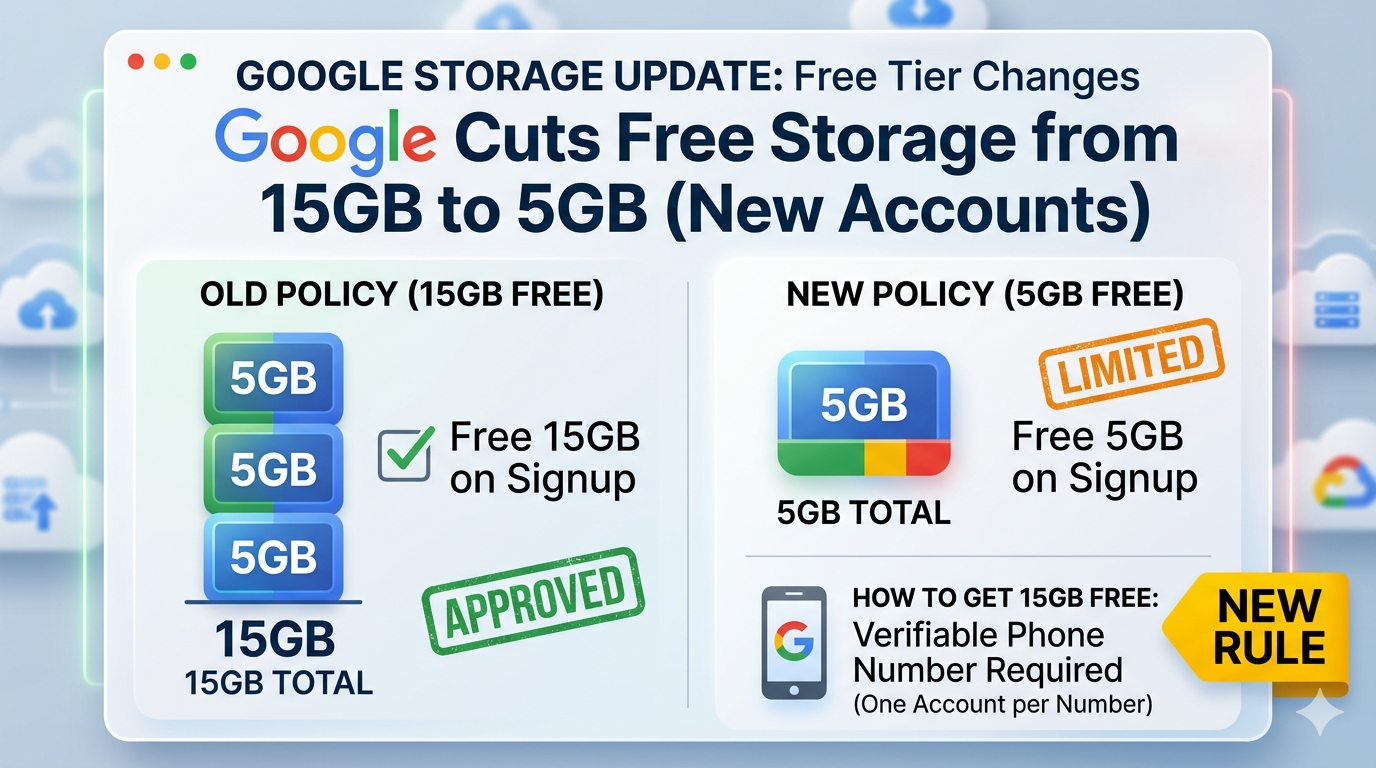
However, for years, having a new Gmail account was associated with one thing: free cloud storage. Whenever you registered for a new Google account, you received 15GB of free cloud storage for Gmail, Google Drive, and Google Photos right away. That became one of the most compelling reasons why so many people chose Google.
Now, however, users have begun to see something that is quite surprising.
As evidenced by some conversations held online and reported by users from different countries, new Google accounts do not get full 15GB of free storage anymore, but instead receive 5GB unless further actions are taken by the user.
Although Google has not officially revealed any major changes on a global scale, this change seems to be related to improved account security, enhanced anti-spamming policies, and Google’s struggle against fake accounts.
This update caught quite a few people off guard.
What Exactly Is Changing?
Previously, creating a Gmail account was simple. Users could sign up with basic details, skip phone verification in some cases, and instantly access the full 15GB of free storage.
Now, the process appears to be different for certain new accounts.
The common complaints by many users include that:
- Fresh user accounts are restricted to just 5 GB storage for a short while
- Google will require mobile number verification before unlocking full 15 GB storage limit
- A single mobile number can be verified for just a few accounts
- Verification less accounts will likely be restricted
It seems that this is one of the new security measures introduced by Google.
Older accounts will largely remain unaffected by these changes.
Why Google May Be Doing This
Over the last few years, fake Google accounts have become a major problem online.
Bots often create thousands of Gmail accounts for:
- Spam emails
- False reviews
- Scams on websites
- YouTube spam messages
- Fraudulent advertising
- Phishing scams
- Automatically generated bot networks
Since Gmail accounts provide access to nearly all Google services, the problem of false account creation has become an increasing cybersecurity issue.
It is thought by industry professionals that Google is now strengthening its sign-up process to combat abuse of their system.
Through mobile verification before offering any increased storage capabilities, Google could be working to make sure that only human users are signing up for accounts.Bots often create thousands of Gmail accounts for:
- Spam emails
- False reviews
- Scams on websites
- YouTube spam messages
- Fraudulent advertising
- Phishing scams
- Automatically generated bot networks
Since Gmail accounts provide access to nearly all Google services, the problem of false account creation has become an increasing cybersecurity issue.
It is thought by industry professionals that Google is now strengthening its sign-up process to combat abuse of their system.
Through mobile verification before offering any increased storage capabilities, Google could be working to make sure that only human users are signing up for accounts.
Phone Number Verification Becomes More Important
One of the biggest parts of this new system appears to be phone number authentication.
Users report that adding a valid mobile number during account creation can help restore or unlock the full 15GB storage allocation.
But another significant shift has been noticed by many people as well.
Users have reported that a single phone number will only work for a restricted number of Gmail IDs, after which Google will prevent further registrations.
This might also be a new security move against bots.
Earlier, spam emailers would use virtual phone numbers or other services to create many Gmail IDs through automation. New verification processes could now be interfering with such activities.
Is This Happening Worldwide?
At the moment, the rollout does not appear fully global or officially confirmed for every region.
Some users still receive the traditional 15GB immediately, while others report storage restrictions during signup.
It shows that Google might be:
Conducting a test of this feature in certain geographic locations
Carrying out anti-abuse testing
Imposing limitations only on suspicious activities associated with accounts
Performing risk analysis through artificial intelligence while signing up for Gmail.
According to technology experts, Google often conducts backend updates silently before making official announcements about changes to its platform.
Thus, the Gmail storage limit policy can be refined further in the coming months.
Users React to the Quiet Change
The online reaction has been mixed.
Some users support the stricter verification system, saying it could reduce spam, scams, and fake activity across Google services.
Others claim that the process is an extra hassle for users looking to make use of a new Gmail account.
Users have also brought up issues regarding privacy and the requirement to verify one’s phone number.
On social networking sites and technological discussion boards, debate on the topic has grown significantly, particularly among those who require more than one account for their work.
The Competitive Landscape: A Unified Industry Retreat
Indeed, it must be stressed here that Google does not work alone on this front. In effect, what is unfolding now is a concerted effort by the entire IT industry to abandon the practice of aggressive loss leader storage competition, which was prominent during the earlier part of the decade. For quite a long period of time, the tech firms employed huge free storage capacities as a means of attracting customers, believing that as soon as a client used up his free storage space, he would simply be hooked into the system and could not afford to leave it behind. However, the reality of the market in 2026 has shown that there is no way of developing sustainably unless one verifies the storage continuously. By reverting back to 5GB of unverified storage, Google is placing itself in the same boat as Apple in terms of the restrictions placed on its base consumer cloud storage space by the iCloud service. Even such veteran web service players as Yahoo mail, having given a huge promise of a free TB of data, has recently decided to limit this capacity drastically and install phone verification filter mechanisms.
| Account Tier Type | Default Storage Capacity | Verification Requirement | Primary System Purpose |
| Unverified New Account | 5 GB Total Space | None (Basic Email Setup) | Drastically reduces system space wasted by automated botfarms and scrapers. |
| Verified New Account | 15 GB Total Space | 1 Unique Mobile Number (Strictly One Account Per Number Limit) | Confirms authentic human footprint; blocks corporate multi-account stacking. |
| Legacy Accounts | 15 GB Total Space | Unaffected (For Now) | Preserves retention for older, grandfathered user accounts while monitoring data hygiene. |
Could This Affect Google Drive and Photos Too?
Because Gmail storage is connected to Google Drive and Google Photos through Google One storage allocation, the impact could extend beyond email itself.
Storage limit being smaller at the start can have an impact on:
- Cloud backup
- Photo uploading in Google Photos
- File sharing
- Synchronization across Android devices
- Drive storage for working and studying purposes
One of the most important features that has allowed Google to stand out from other cloud ecosystems is free 15GB storage space.
With verification becoming stricter in the future, Google might change its strategy regarding new users.
The Bigger Picture Behind Google’s Security Push
This change comes at a time when major tech companies are aggressively fighting AI-generated spam and automated abuse systems.
These include Google, Meta, Microsoft, and X who are making huge investments in:
- Identity verification
- Artificial intelligence (AI) bots
- Anti-spam mechanisms
- Behavioral analysis tools
- Device fingerprinting techniques
As technology evolves, fake accounts can now only be detected through new and improved techniques.
This is why there is an increase in the use of a combination of phone verification, device identification, and behavioral analysis by businesses to detect suspicious behavior.
The possible storage limits for Gmail by Google could just be part of this industry trend.
What Users Should Do
For those who plan to create an account on Gmail and find limited storage space, the following tips are advised by specialists:
- Enter your mobile phone number while signing up
- Don’t try to make many accounts at once
- Sign up through official Google websites
- Enable account recovery option
- Confirm your identity if asked
One should not use fake mobile phone numbers from various online temporary providers, since they might be blacklisted by Google already.

Leave a Reply